 Bestseller
The ADFA (Advance Diploma in Financial Accounting) is a 1-year (12-month) job-oriented computer diploma course designed to cover computer fundamentals, office automation, manual accounting, computerized accounting, and taxation.
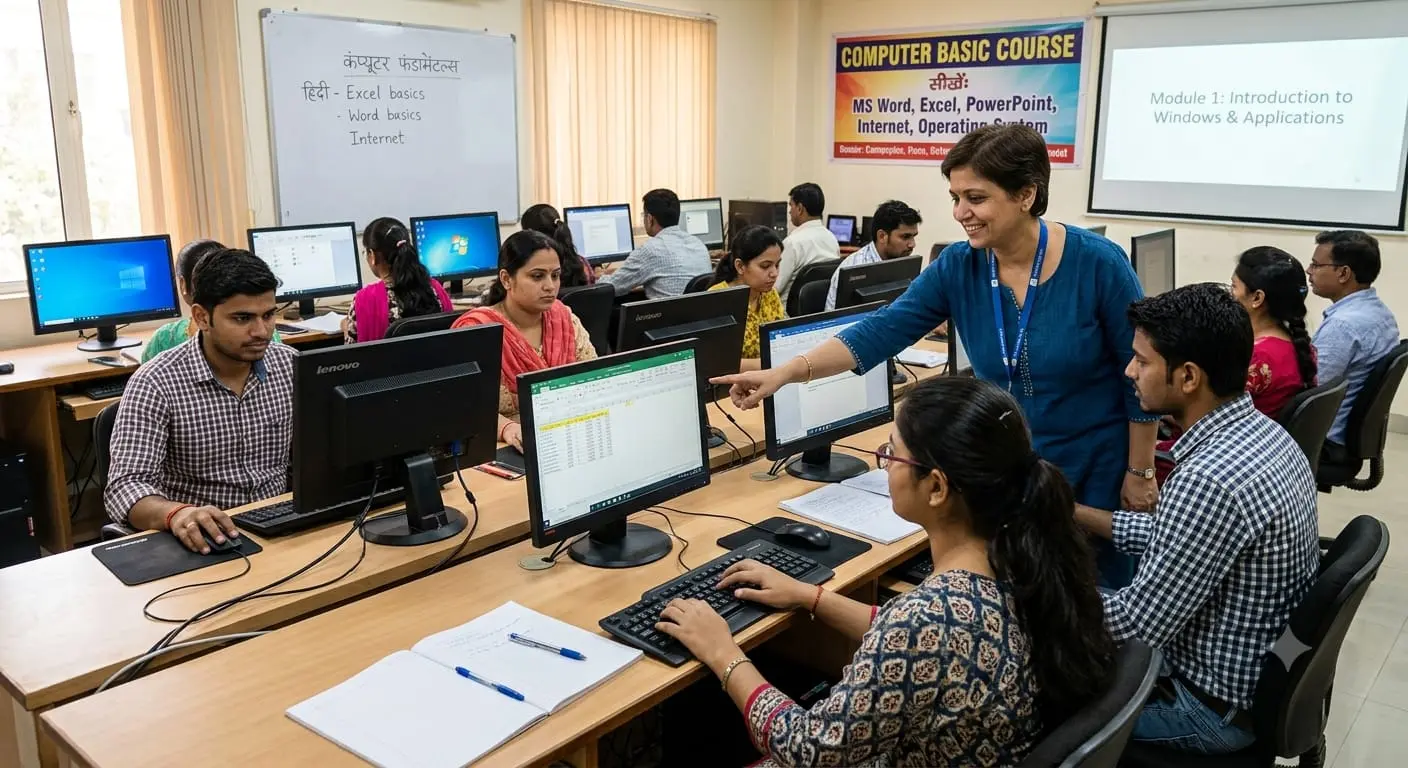
Semester 1: Computer Fundamentals & Office Automation
Module 1: Computer Concepts & Operating Systems
Computer Fundamentals: Hardware, Software, Input/Output devices, Storage devices.
Operating Systems: Windows OS, File & Folder Management, Control Panel, System Tools.
Typing & Essentials: English/Hindi typing basics, Keyboard shortcuts.
Internet & Web Applications: Web Browsing, Email Management, Online Services, Digital Banking, Cyber Safety.
Module 2: Microsoft Office Suite
MS Word: Document formatting, Mail Merge, Tables, Header/Footer, Official Correspondence.
MS PowerPoint: Presentation design, Slide Transitions, Custom Animations, Audio/Video embedding.
MS Access / Database Management: Database Creation, Queries, Forms, and Reports.
Module 3: Advanced Excel & MIS Reporting
Spreadsheet Basics: Cell referencing, formatting, formulas & shortcuts.
Advanced Formulas: VLOOKUP, XLOOKUP, HLOOKUP, INDEX-MATCH, Logical Functions (IF, AND, OR), Text & Date Functions.
Data Analysis Tools: Data Validation, Conditional Formatting, Goal Seek, Scenario Manager, Data Tables.
Pivot Tables & Charts: Pivot Reports, Slicers, Calculated Fields, Dynamic Dashboards.
MIS Reporting: Financial Modeling, Profit & Loss Analysis, Expense Tracking.
Semester 2: Accounting, Tally & E-Taxation
Module 4: Manual Financial Accounting
Basic Accounting Concepts: Golden Rules of Accounting, Debit & Credit rules.
Books of Accounts: Journal Entries, Ledger Posting, Cash Book, Subsidiary Books.
Trial Balance & Final Accounts: Preparation of Trading Account, Profit & Loss Account, and Balance Sheet.
Bank Reconciliation Statement (BRS): Matching cash book with bank statement.
Module 5: Computerized Accounting with Tally Prime / Tally.ERP 9
Company Setup: Creation, Alteration, Shutting down companies, Security Control, Data Backup & Restore.
Masters Creation: Ledger & Group Creation, Cost Centers & Cost Categories.
Voucher Entry: Payment, Receipt, Contra, Journal, Sales, Purchase, Credit/Debit Notes.
Inventory Management: Stock Groups, Stock Items, Units of Measure, Godown Management, Purchase/Sales Order Processing.
Payroll Management: Employee Groups, Pay Heads, Salary Processing, Attendance & Payslip Generation.
Financial Reports: Trial Balance, Balance Sheet, P&L Statement, Cash/Fund Flow Statements, Stock Summary.
Module 6: GST (Goods & Services Tax)
GST Fundamentals: CGST, SGST, IGST, UTGST, Tax Rates, HSN/SAC Codes.
GST Transactions in Tally: Invoicing with GST, Input Tax Credit (ITC), Reverse Charge Mechanism (RCM).
GST Returns & E-Filing: GSTR-1, GSTR-3B, GSTR-4 (Composition Scheme), E-Way Bill generation, GST Portal navigation & registration.
Module 7: Direct Tax & E-Filing (TDS, TCS & Income Tax)
TDS & TCS: Concepts, Rates, Ledger Setup in Tally, Voucher Entry with TDS, Challan 281.
Income Tax Basics: Heads of Income, Deductions (80C, 80D, etc.), Computation of Income Tax.
E-Filing Portal: PAN/TAN Application, ITR Preparation (ITR-1, ITR-4), Online Return Filing & Form downloads.
Module 8: Practical Project Work & Viva
Real-world company accounting case studies.
Live GST & TDS Return filing simulation.
Comprehensive project evaluation and practical lab test.
Career Scope After ADFA
Accounts Assistant / Executive
Tally Operator / Billing Executive
MIS / Excel Data Analyst
GST Return Practitioner
Payroll Executive
Copyright © 2026 𝐌𝐒 𝐈𝐧𝐬𝐭𝐢𝐭𝐮𝐭𝐞 𝐅𝐨𝐫 𝐒𝐤𝐢𝐥𝐥 𝐃𝐞𝐯𝐞𝐥𝐨𝐩𝐦𝐞𝐧𝐭. All Rights Reserved